Short-Form Video
I watch a lot of reels. I decided to try and make some of my own.
Online Content
Last year, I learned about the 1% rule, which is the idea that most internet users only lurk. According to the rule, all content is created by about 1% of people. About 9% of people contribute, usually by commenting, and 90% of people lurk, only consuming content. While this may not be 100% accurate, it's a valuable rule of thumb, and it made me think about my internet use.
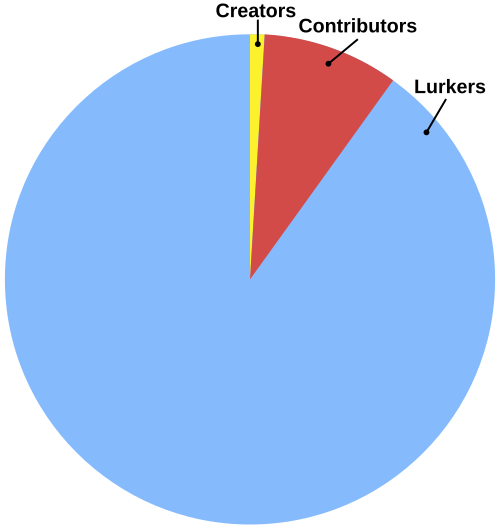
I want to contribute instead of just absorbing. I want to be in that top 1% that creates. In several areas, I already am — I publish academic papers and write these blog posts. And I know they're being read. My articles are getting cited, and after adding web analytics to my personal site, I found people visit my site and read my posts. I also started my Lego Instagram this year and I get hundreds to thousands of views on each original Lego creation I post.
I also waste a bunch of time on social media. In particular, this year I found myself getting sucked into short-form content from time to time (Instagram Reels, Youtube Shorts). I decided that if I'm going to absorb that much short-form video content, I should create some as well.
An Extremely Brief History of Online Content
When I was born, there was no such occupation as a "content creator". The entertainment industry was a walled bastion, and very few independent creators were able to get their art in front of the masses. When sites like YouTube launched 20 years ago, this all changed. The internet democratized content creation. Anybody could create and share content, and if the content was funny/interesting enough, it might go viral and get tons of exposure. These sites made money from ads, and they shared this ad revenue with popular creators.
Social media sites, which were originally designed for people to share information with their friends and family, evolved to take on the function of content-sharing platforms. While social media was primarily for connecting with others, nowadays, sites like Instagram and Facebook are sure to present you with plenty of "content" that has nothing to do with your friends and loved ones.
Short-Form Video
Short-form video really started to pop off in 2012 with the creation of Vine. On this site, people could create videos up to 6 seconds long, and share them. As the saying goes, restrictions breed creativity, and the time restriction made Vine immensely popular. Many of today's content creators got their start on Vine.
However, Vine shut down after a few years, and short-form video wasn't too popular until about 2020, when it exploded in popularity. The Chinese app TikTok reached 1 billion users faster than Facebook, Instagram, and YouTube. Hoping to capitalize on this, most social media sites added dedicated sections for short-form video content.
There's evidence that short-form video is bad for our attention spans, and concerns that it spikes our dopamine in negative ways. I've taken steps to decrease my intake of short-form content, including deleting the YouTube app from my phone, and setting screen time limits on Instagram.
However, I don't think that short-form videos are inherently bad. I think they can be really fun and funny. As you probably know, I've made some short (hopefully funny) videos in the past. As I was watching some reels the other day, I asked myself, "How hard could this be?", and decided to try my hand at making some reels of my own.
Making the Videos
I often get myself into trouble with thoughts of, "I bet I could do that." It turns out that doing something well/doing something right is often a lot more work than it seems. This lesson was reiterated as I spent hours and hours over Christmas making a few really dumb short videos.
Here are a few of the videos I made, with a description of the creation process, from idea to execution:
Something Under the Bed
I've seen a lot of content around sugar-free Monster energy drinks this year. These Monsters, which come in a white can, have risen to great popularity, especially in fitness content. There's something about the caffeinated beverage that is used as a stand-in for energy or maybe even a hint of badassery. At the same time, there's a hint of irony in choosing a sugar-free (healthy) drink that's entirely made of artificial chemicals.
While at my in-law's house after Christmas, I decided to tap into the popularity of the White Monster and make the following video.
The idea with this was to lean into a punchline you could see coming a mile away. For the second time in my life, I roped Porter (my youngest brother) into filming a dumb video with me. I ran through all the rooms in my in-laws house and found which bed a can of Monster would fit best under (Monster cans are pretty tall.) Then, I shot several takes of Porter 'scared' in bed. I had to reposition his head, hands, pillows, and camera, until I got a shot that looked right.
After that, I put my phone where Porter was sleeping and got a few takes of me looking down at him.
I knew that audio would be an important component of the joke. I went on Spotify and listened to songs like Monster by Kanye West, Monster by Meg and Dia, and Monster by Lady Gaga. I decided on the Meg and Dia version, as the rock aesthetic fit best with the connotations surrounding white Monster drinks.
I actually worked through three different versions of the script that involved different amounts of back-and-forth between the parent and child. After locking in the dialogue, I downloaded CapCut which is software specifically for creating short-form videos. I cut everything together, added the subtitles, and added digital zoom to the end of the reel to punch in on the Monster can and drive the joke home. At this point, I realized the audio from the Meg and Dia song didn't quite fit, so I speeded it up about 15%. I also didn't want the lyrics of the song before the punchline to distract from the subtitles, so I ran it through high-pass and low-pass filters to make it sound muted and distant.
I shared the reel with my family, and ended up changing the wording three more times before settling on the final draft, which I think turned out very well.
The Ideal Wedding
My second (and third) videos were variations on the same idea. A couple of years ago, I made a meme song where I wove a bunch of songs into Tchaikovsky's Dance of the Sugar Plum Fairies. I had the idea to do this with Johan Pachabel's Canon in D. I worked on it for a little while, and decided not to go through with it. However, I did have a few little pieces that I liked that I wanted to use.
While I'm still not an amazing composer, I've gotten a lot better at arranging and creating music like this over the past several years. (check out an original song I composed for my Mom here.)
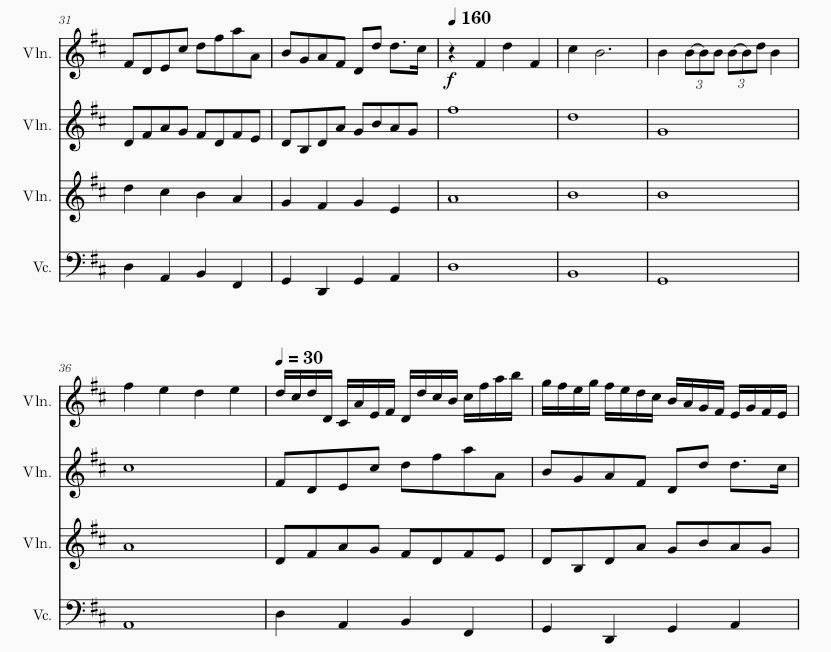
After creating the arrangement, I made sure to do a little post processing. I panned each instrument over partially to one ear, and added some reverb to make the synthesized instruments sound more like they're actually being played in a real room.
Here's the final cut of the reel:
The joke here is based on the seamless transition in the music from Canon in D (associated with weddings) and Join us for a Bite. (Covered in this post) The buildup is designed to trick the user into thinking they're watching a wedding inspiration reel. The punchline breaks as the bride is revealed to be Chica from Five Nights at Freddy's.
Making this reel was a lot of work, too. I found all the wedding images on Unsplash (a site where photographers share their photos for free). Among these were a couple of photos of a real bride. Since I was going to be covering her face, I felt fine using them. Then I had to add Chica's face to the bride images, and crop everything to 9x16 aspect ratio, perfect for short-form content. After that, I needed to line everything up so the images transitioned with the music, and add some transition effects to the 'bride' reveal.
Join us for a Bite is pretty silly, popular song. But I wanted to try an additional idea for the reel, which was a little edgier.
Ideal Wedding Version 2
Earlier this year 24-time Grammy-award-winning rapper Ye (Kanye West) released a controversial song. While he is no stranger to controversy, this song was a lot, even for him, and was removed from all major streaming services within one day of its release for its antisemitic content. Ye later released an instrumental version. Since I try to keep my blog PG, I've decided to only include the instrumental version on this page.
This incident was a cultural moment in the US, sparking debates about freedom of expression and concerns for West's mental well-being. The blatant use of antisemitic themes also came at a time when Israel and Palestine have been essentially at war for over a year. The brazen controversial lyrics made the song very salient in meme culture. Several of the memes replaced the controversial lyrics being replaced with innocent themes, like a Kidz Bop-type parody, or a Christmas remix. These achieved widespread popularity because of the juxtaposition of the source material with a pure and innocent context.
All of this made me want to apply the song to another pure context, a wedding. I was able to re-use what I had done with the last version of the reel, with a few changes. First: part of what makes the original song so catchy is the strong bass. To capture this, I added a Contrabass part to my string quartet arrangement. I also needed a few more 'bride' pictures, which I generated with AI using the real photos as reference.
With all of that done, I had a second version of the reel:
Edits
One type of short-form video content is called an 'Edit', where footage from a movie or tv show is paired with effects and music to accentuate a cool character. I was talking to my brother and said, "I feel like I could learn how to make edits if I tried for a few hours." He agreed it didn't seem too hard, and the rest was history. I decided to give it a try, making a couple of edits to see if they were really that difficult.
Edit Music
Edits are built around the music. The visuals should sync to the beat, and the mood of the edit is determined by the song. Music for these short edits are usually taken from subsets of Trap or EDM (Electronic Dance Music), including Phonk and Breakcore
I listened to a lot of songs by a lot artists before deciding to use a couple of tracks by KORDHELL, a prominent Phonk artist.The Characters
While most edits are serious, the edits that I've found most entertaining have all featured relatively minor/uncool characters. Since I wanted this to be funny, I called my brother to brainstorm, and he helped me decide on a couple of characters to make edits of.
Edit #1
Making an edit is harder than it seems (are you sensing a theme with this post?) This one, for example, involved more than 25 clips, each of which had to be sized and positioned to fit on a phone screen. From there, I applied more than 25 different effects to the audio and video to finish the edit.
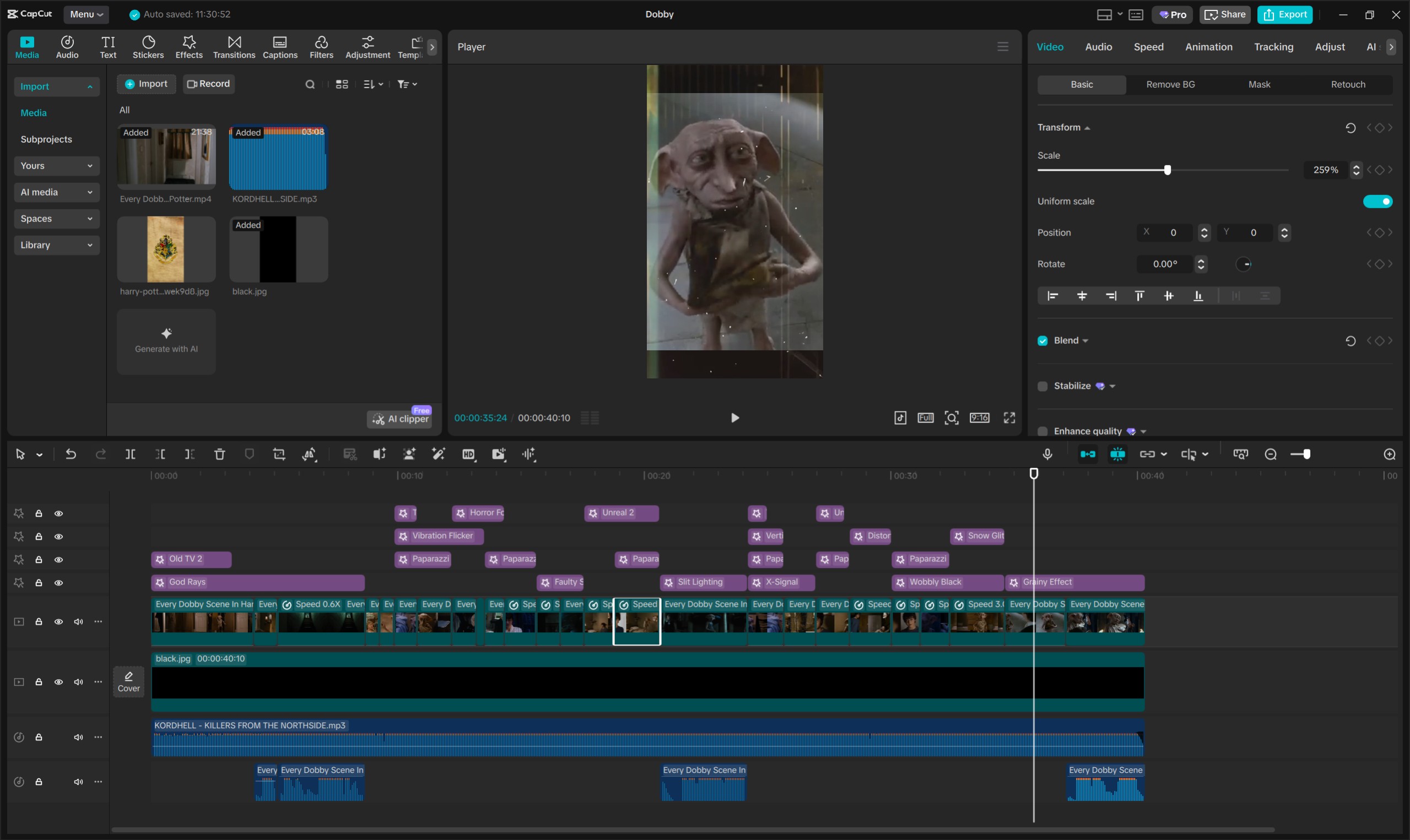
Give it a watch.
Edit #2
Dobby is a minor character from Harry Potter, and pretty ugly. This makes him a pretty good candidate for an edit. However, I recently learned about a Star Wars-specific term, the Glup Shitto. This satirical name refers to minor characters in Star Wars who have received a disproportionate amount of attention from hardcore fans. Star Wars fans can be pretty hardcore, and I have had multiple conversations where people have told me that there favorite Star Wars character is Babu Frik or Wat Tambor.
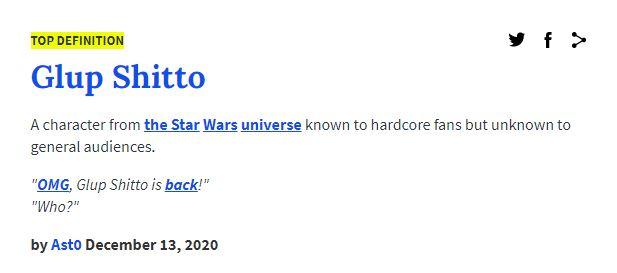
I knew I wanted one of my edits to be of one of these characters who has very little screen time, and I had a lot to choose from. As a note - even if you've seen all of the Star Wars movies, you probably don't know any of these guys' names, and it's even unlikely that you'd remember seeing them before.
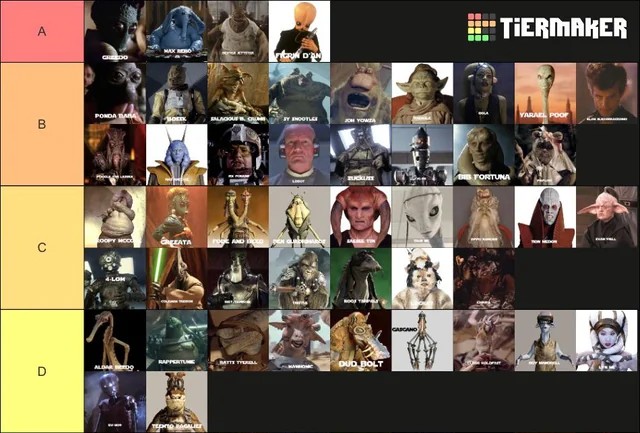
Of course, I decided to choose Ben Quadrinaros as the subject for my first edit. Quadrinaros appears briefly in Star Wars Episode 1: The Phantom Menace, as a podracer in the Boonta Eve classic. His podracer fails to start, and he never leaves the finish line. In spite of all of this (and the fact that he only gets like 30 seconds of screen time and no dialogue) he is beloved by fans.
So I got to work. Thankfully, getting all of the existing footage of Quadrinaros was really easy since there is almost none. He also appears in a couple of non-canon Lego Star Wars shows, which I thought would be funny to throw in.
I wanted to make this one a bait-and-switch, where it seems like a Star Wars character ranking (nerds love to discuss this sort of thing). To do this, I filmed myself doing an intro in a pretty nerdy voice, that transitions seamlessly to the edit.
Getting the most out of old work
If I was going to try making reels, I might as well get as much as possible out of my old work. I've seen countless content creators cut up their old videos to create reels after short-form video became popular. To this end, I resized my Join us for a Bite reel and my Black Bolt reel. I also made a little music video to go with my Fetty Wap Audio by chopping up and filtering some of the original music video.
Posting
Of course, creating the reels and not posting them on social media is like lighting a candle and hiding it under a bushel. I decided to create a brand-new social media account and post the reels and see how they were doing after a week.
The experiment was a little iffy, since social media algorithms want you to post once a day instead of all at once. To maximize engagement, I posted a reel roughly once a day for about a week, so at the end of the experiment the last reel was only up for about 48 hours and the first one was up for over a week.
To start off, I created a TikTok account. TikTok is built around discovering new short-form video, so it seemed like the best place for getting things kicked off. I read a bunch of creator tips for how to tag and caption the videos to maximize engagement.
In order to keep the experiment rigorous, I didn't tell anyone in my friends or family where to find it (so they couldn't give the videos undeserved likes).
The Results
I uploaded my first video, (the ideal wedding one) waited for a day, and got some bad news. Nobody got to the punchline. In fact, people scrolled away from the video after an average of 1.3 seconds.
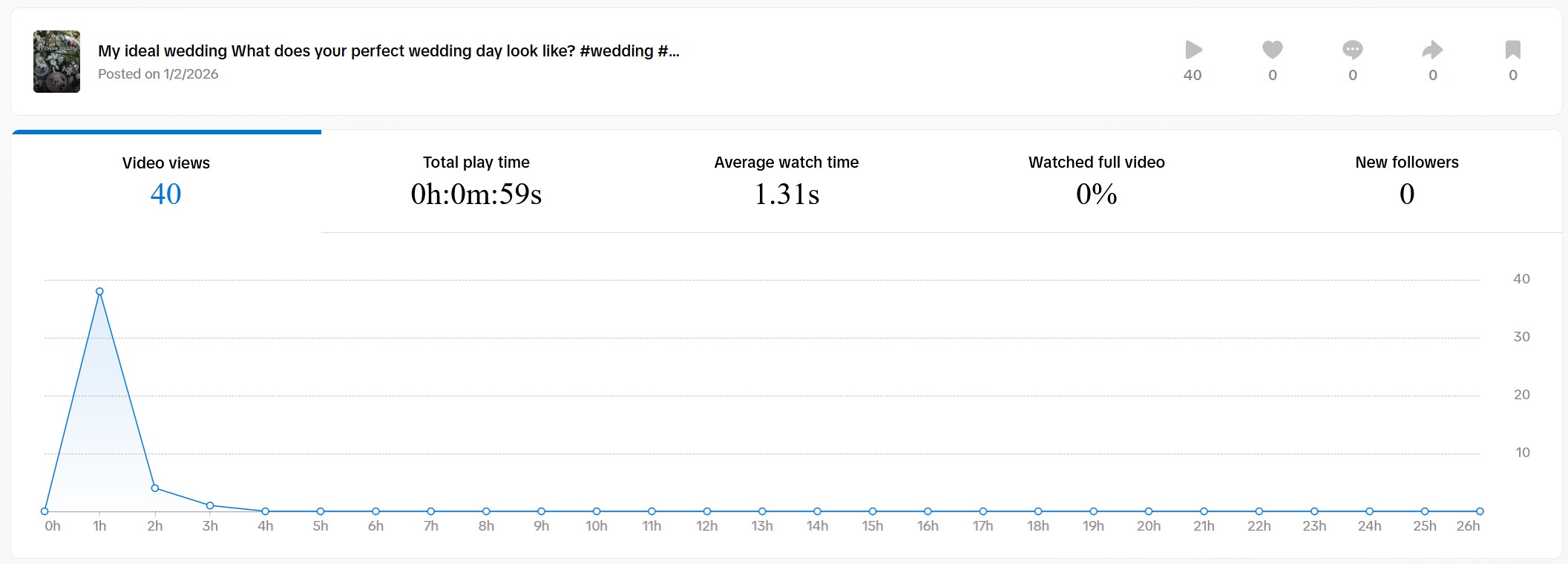
It turns out that people who get a random reel on their FYP don't tend to wait in anticipation of a payoff. This kind of makes sense to me. People who are doomscrolling are looking for immediate dopamine hits. In this state, people aren't willing to wait a few seconds for a payoff, if they could just swipe to a potentially better video. People who see me on their FYP don't have any reason not to swipe away.
And this didn't just happen with the 'ideal wedding' reels. The same thing happened with the Ben Quadrinaros edit, too.
This is a disappointment. I worked hard on those videos and was too bad that nobody saw the funny payoff.
My Black Bolt reel was also flagged as 'low-effort content' by TikTok, resulting in their not recommending it to very many people. I put a lot of work into editing the video, so it was a little rude that they called it low-effort content. Apparently, their algorithm considered it 'a sequence of still images or GIFs', which is more an artefact of the animation style of the show than anything else.
In spite of all that, people actually saw my videos. I got over 1,000 views, 70ish likes, and 12 shares.
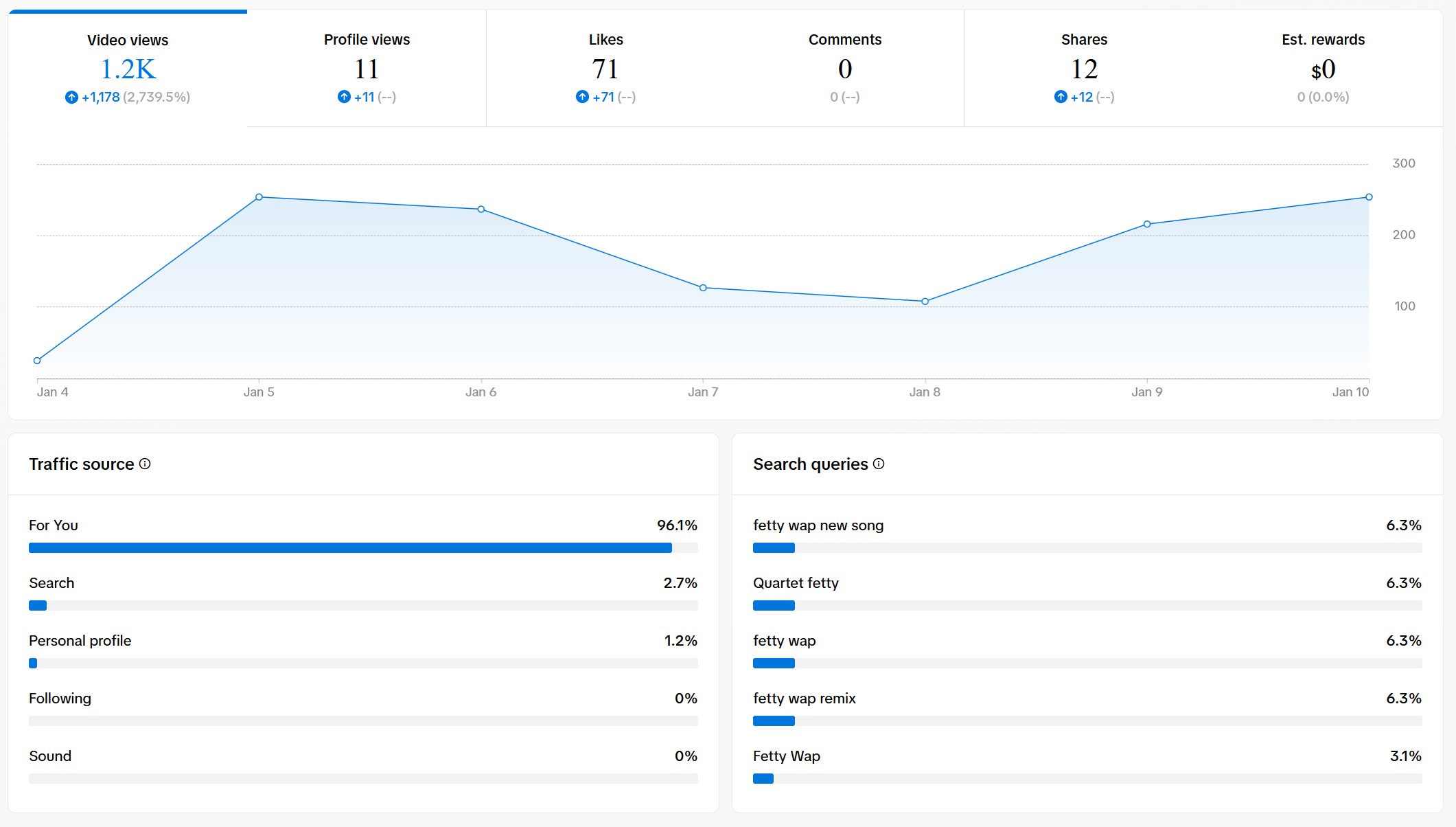
That doesn't seem very good (any single post on Alex Lyman Studios gets that many likes), but when you consider that none of these people chose to follow me, it's a little bit cooler how many of them saw and enjoyed my content.
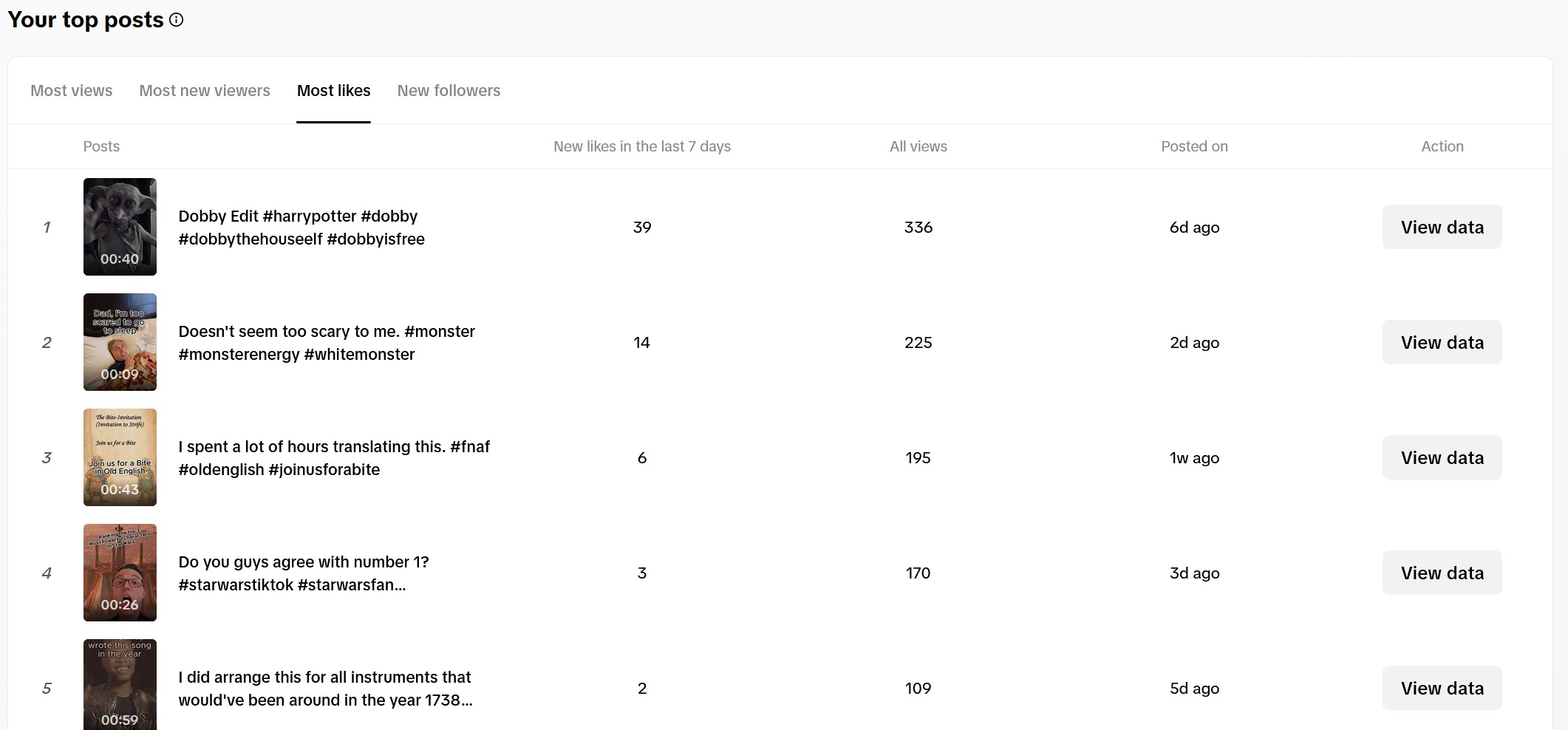
My lesson learned earlier about grabbing people's attention was true here as well. The videos that people liked the most were ones that you could immediately tell what was going on, and didn't have to wait for a payoff.
Conclusion
My main goal with this project was to make some funny reels, and I did that. Even though none of my reels went viral, I had fun bringing my ideas to life. Now that the experiment is over, I can link my TikTok if you want to check out the reels there.